The PKZEE Method™
A Five-Stage Method for Transformation Clarity, Stability, and Excellence
PKZEE does not manage your transformation. It ensures your transformation does not fail under your leadership. PKZEE complements your leadership — it restores the conditions under which leadership can succeed.
The method was developed through 35 years of lived experience inside enterprise transformations — not studying them from the outside, but carrying personal accountability for their outcomes. Across 40+ organizations, six sectors, and programs ranging from $5M to $500M+, the same patterns of failure and success repeated. The PKZEE Method is what those patterns teach.
What distinguishes this method is not its structure — it is the depth of human understanding it brings to organizational work. Every stage combines the rigor of transformation architecture with the insight of ICF MCC-credentialed coaching mastery. The result is a method that fixes the systems and develops the leaders simultaneously — and leaves the organization more capable than it found itself.
What Makes This Method Different
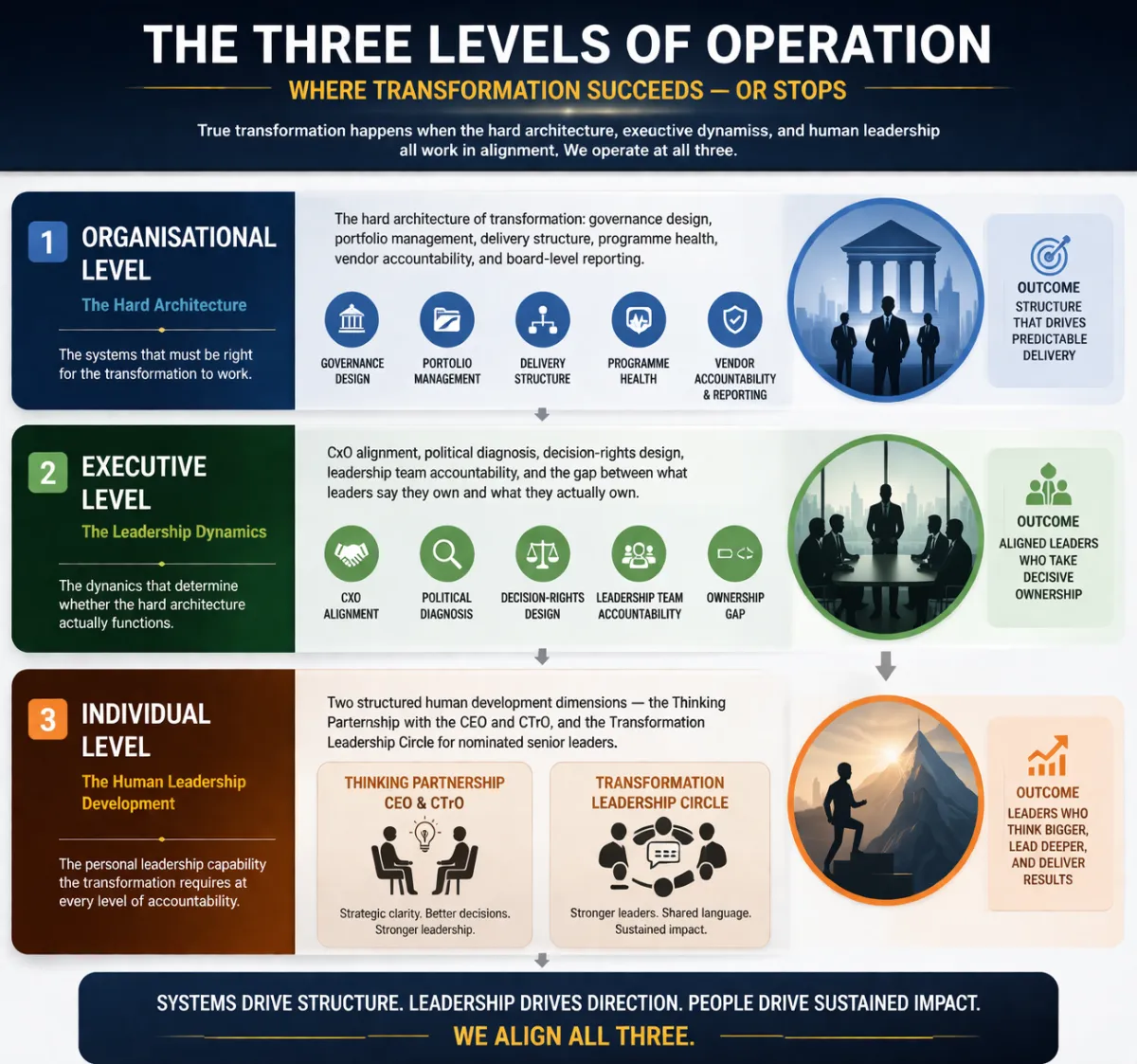
Most transformation methodologies address the organizational level. Most coaching approaches address the individual level. Almost nothing addresses both simultaneously, with personal accountability for what both produce. That integration is what the PKZEE Method uniquely delivers — and it is the reason the outcomes hold after the engagement concludes.
The method is powered by two things that are rarely found together in one practitioner: 35+ years of cross-industry pattern recognition across transformation success and failure, and ICF MCC coaching mastery that surfaces the human dynamics that structural interventions alone cannot reach. Combined, they produce clarity where there was confusion, stability where there was drift, and leadership capability where there was dependency.
THE FIVE STAGES
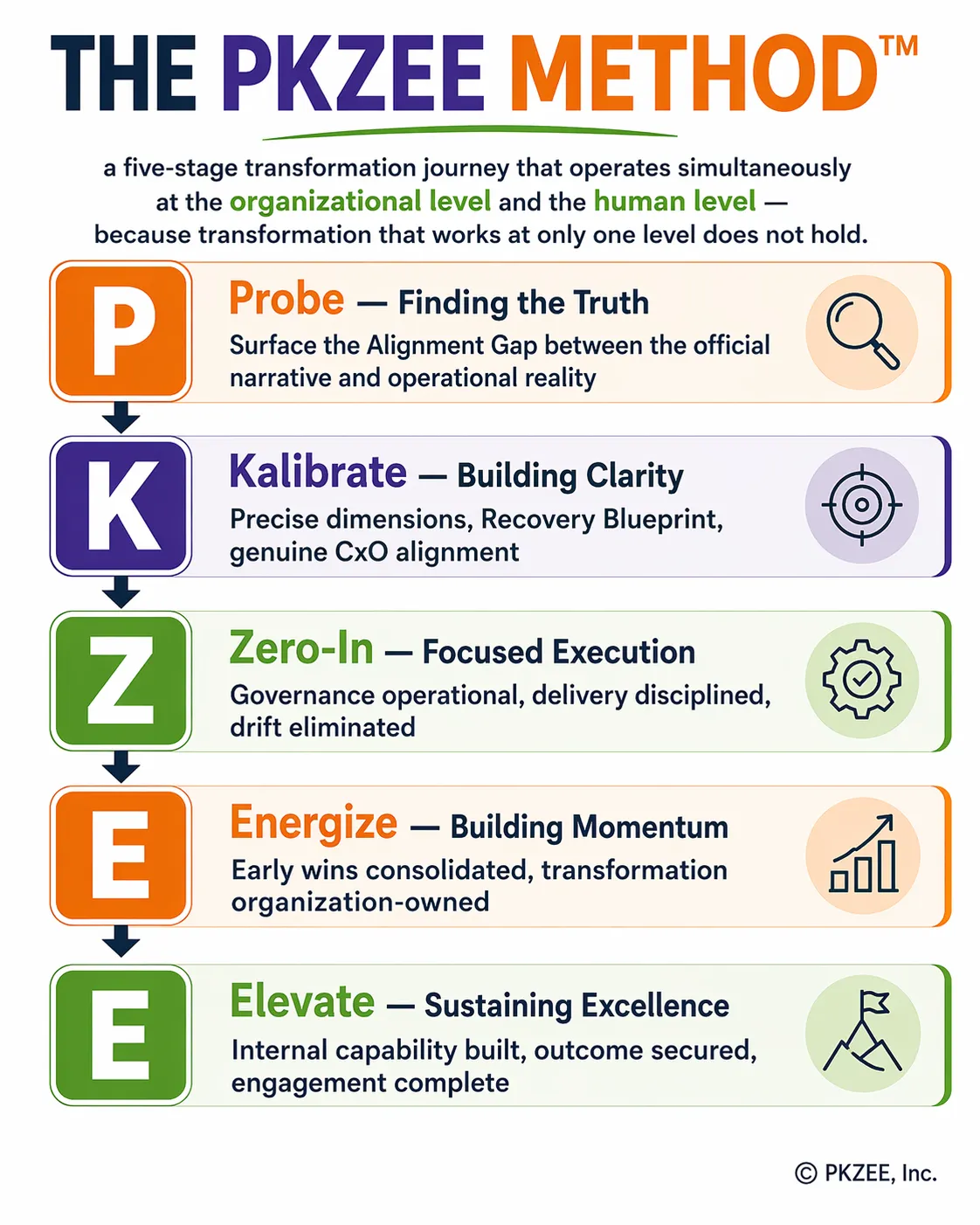
The name PKZEE encodes the five stages of the method. Each stage has a clear purpose in the transformation journey, a set of outcomes it builds, and a leadership development dimension running alongside the organizational work. The stages are sequential in their logic — each one creates the conditions for the next — but the leadership dimension runs continuously throughout all five.
| Stage | Name | The Journey | |
|---|---|---|---|
| P | Probe | Finding the Truth | Surface the gap between what the transformation reports and what is actually happening. Name what others cannot name. |
| K | Kalibrate | Building Clarity | Give the gap precise dimensions. Align leadership on what it requires. Rebuild the accountability and decision-making architecture. |
| Z | Zero-In | Focused Execution | Bring disciplined, focused execution to the clarified roadmap. Governance active. Cadence established. Drift eliminated. |
| E | Energise | Building Momentum | Consolidate the gains. Shift the transformation from program-dependent to organization-owned. Leadership confidence becomes self-reinforcing. |
| E | Elevate | Sustaining Excellence | Build the internal capability that sustains the transformation after the engagement concludes. The organization is more capable than when it began. |
P
Probe — Finding the Truth
The honest picture — surfaced, evidenced, and named
Every transformation carries a gap between its official story and its operational reality. Probe is the stage where that gap is found. Not through a standard diagnostic checklist — through the kind of deep, politically courageous listening that only happens when the person doing it has no stake in the existing narrative and no comfort in managed answers. Probe moves through governance, delivery health, leadership dynamics, and organizational culture to surface the Alignment Gap: the specific, evidenced distance between what the program reports and what is actually happening. This is the stage where patterns from 35+ years and 40+ organizations become most visible — because the failure modes that have destroyed other transformations are recognizable long before they become irreversible here.
What You Build in This Stage
A complete honest diagnostic of the transformation's structural health, governance effectiveness, delivery cadence, and leadership dynamics
The Alignment Gap — precisely evidenced and named: what the official story says, what the operational reality shows, and what that gap is costing
The political and human dynamics that are limiting the transformation's progress — surfaced with care, named with honesty
Strategic clarity about where the transformation is, why it is there, and what it genuinely requires
Leadership Development Dimension
The CEO and CTrO are asked questions they have not been asked before — about their own role in the gap, their private assessment of the transformation's health, and the decisions they have been avoiding
The Thinking Partnership begins here: structured monthly sessions and open-line access that create the conditions for honest reflection at the level where it matters most
The leaders who will form the Transformation Leadership Circle are identified — their individual strengths, gaps, and development needs surfaced as part of the diagnostic
K
Kalibrate — Building Clarity
Precise alignment — on the gap, on what it requires, and on who owns it
Clarity without alignment is insight without action. Kalibrate takes what Probe has surfaced and gives it the precise architecture that makes it actionable. The Alignment Gap is given specific dimensions and assigned to specific causes. The accountability structure is rebuilt — not around the org chart, but around what the transformation actually requires. The political dynamics that Probe surfaced are addressed in the room where the relevant leaders sit. Decision rights are renegotiated. The leadership team moves from the comfortable position of knowing there is a problem to the uncomfortable but productive position of owning their part in it. This is the stage where honest leadership conversations happen — facilitated with the skill of an ICF MCC coach and the authority of someone who has seen this pattern resolve and fail across 40+ organizations.
What You Build in This Stage
A Recovery Blueprint — the specific, accountable, sequenced roadmap that closes the Alignment Gap, with named ownership at the CxO level
A redesigned decision-rights architecture — who decides what, with what authority, by when, and with what accountability if decisions are not made
CxO alignment sessions that produce genuine shared ownership, not public endorsement of a plan the leadership team privately doubts
Strategic confidence — the CEO and leadership team operating with a clear, honest picture of where the transformation is and exactly what it requires
Leadership Development Dimension
The hardest leadership conversations of the engagement happen in Kalibrate — facilitated with both diagnostic rigor and human depth
The CEO and CTrO are supported through the experience of accepting a picture of their organization that is different from the one they have been managing
The Transformation Leadership Circle launches in Kalibrate — their first group session establishes shared understanding of the real transformation status and each member's specific accountability within it
Z
Zero-In — Focused Execution
Precision, discipline, and momentum — with no room for drift
Zero-In is where the clarity and alignment built in Probe and Kalibrate becomes live execution. The transformation's governance rhythm is established. Portfolio management is operational. Delivery cadence is consistent. Issues and risks are addressed at the point where they can still be resolved rather than after they have compounded. This stage is named deliberately — because the most common failure mode at this point in a transformation is not incompetence, it is drift. The subtle loosening of discipline, the gradual return of the old governance patterns, the decisions that slip a week and then a month. Zero-In is the commitment to precision — bringing the full force of 35 years of execution pattern recognition to the moment in the transformation where discipline matters most.
What You Build in This Stage
Lean portfolio management fully operational — priority setting, capacity allocation, dependency management, delivery cadence
Governance rhythm established and holding — steering committee, working groups, and escalation pathways functioning with the speed and transparency the transformation requires
Real-time delivery health monitoring that tells the truth to decision-makers rather than managing their perception
Early warning capability — problems surfaced and addressed at the point where action is still inexpensive
Vendor and partner accountability active — external dependencies held to the same standards as internal delivery
Leadership Development Dimension
This is where the pressure on individual leaders peaks — Zero-In is the stage that most tests leadership clarity, confidence, and decision discipline
The Thinking Partnership is at its most active: structured sessions plus real-time open-line access for the moments when a leader needs clarity, not another governance meeting
The Transformation Leadership Circle operates at full intensity — group sessions build collective accountability under pressure; individual sessions provide the decision clarity and confidence each leader needs to perform at their highest
E
Energise — Building Momentum
From program-dependent to organization-owned
Energise is the moment the transformation changes character. Delivery is running. Early wins are accumulating. The leadership team begins to feel the difference between a transformation happening to the organization and one the organization is genuinely doing. This shift — from managed compliance to genuine ownership — is not automatic. It requires deliberate work: consolidating the wins into durable governance practices, building the leadership team's confidence until it becomes self-reinforcing, ensuring that the organization's story of its own transformation is honest, consistent, and owned by the leadership rather than managed by external support. Energise is where the transformation stops being Prem's work and starts becoming the organization's own.
What You Build in This Stage
Early wins consolidated into durable governance practices that do not require external enforcement to hold
Leadership team capability and confidence built to the point where the transformation's momentum is self-reinforcing
Organizational communication and narrative management — the transformation's story is honest, consistent, and owned by the leadership team
Stakeholder confidence — board, investors, wider organization, and external partners have an accurate, credible picture of the transformation's real progress
Leadership Development Dimension
The Thinking Partnership shifts in character: from problem-solving to strategic development, from responding to shaping
The CEO and CTrO are increasingly driving the transformation rather than responding to it — the sessions become more forward-looking, more about their own leadership growth
The Transformation Leadership Circle focuses on building each member's workstream independence — the question shifts from "what needs to be fixed" to "what would this look like without external support"
The Qualified and Aspiring Executives Cohort is most actively developing in this stage — their growing capability directly supports the organization's ownership of the transformation
E
Elevate — Sustaining Excellence
The organization is more capable than when it began
Elevate is the final stage and the most strategically important one. The transformation is on track. The governance is holding. The leadership team is operating with a clarity and confidence that did not exist at the beginning of the engagement. The work of Elevate is to make all of that permanent — to build the internal transformation leadership capability that means the next disruption, the next program, the next strategic challenge does not require an external practitioner to navigate. The engagement does not end when the transformation is stable. It ends when the organization genuinely owns its own capability to sustain transformation excellence — and when every leader who participated has grown in ways that outlast the engagement itself.
What You Build in This Stage
Internal transformation capability built — the organization's own leaders developed to carry the method, the governance discipline, and the leadership standards forward
Cultural embedding — the behaviors, norms, and accountability practices that make transformation the organization's default operating mode rather than a periodic crisis response
Transformation succession design — the internal roles, responsibilities, and development pathways that sustain governance independently
Strategic planning integration — the transformation's outcomes connected to the organization's long-term objectives at board and executive level
A formal engagement conclusion — accountability fully transferred, lessons documented, dependency on external support eliminated
Leadership Development Dimension
The Thinking Partnership concludes with a deliberate transition — the CEO and CTrO are given the frameworks, self-awareness, and reflective practice to continue independently
The final Thinking Partnership sessions focus on three questions: What have you learned about how you lead? What will you do differently in the next transformation? What do you still need to build in yourself?
The Transformation Leadership Circle concludes with a formal accountability transfer — each member presents what they are carrying forward and what internal structures they are building
Private MCC Coaching for Career Upgrade is active for leaders preparing for the next level of executive responsibility — the final stage of the engagement is also a launching point for individual careers
How the Method Aligns with the Four-Phase Offer
The PKZEE Method has five stages. The PKZEE Offer is structured as four client-facing phases. These are consistent — they serve different audiences. The method describes the intellectual and leadership journey. The offer describes the client experience.
| Offer Phase | Method Stages | What the Client Experiences |
|---|---|---|
| Phase 1 — Entry and Alignment | Pre-method on-ramp | Scope, success criteria, Pre-Mortem, and readiness established before the method begins |
| Phase 2 — Discovery and Foundations | Probe + Kalibrate | The honest picture surfaced. The Recovery Blueprint built. Strategic clarity and alignment restored. |
| Phase 3 — Stabilization and Momentum | Zero-In + Energise | Disciplined execution. Governance holding. Early wins consolidated. Transformation genuinely owned. |
| Phase 4 — Stewardship and Excellence | Elevate | Internal capability built. Leadership elevated. The organization sustains its own transformation. |
Self-Positioning for Executive Roles
Self-Positioning for Executive Roles is the Leadership Elevation methodology for individual advancement. Where the five-stage PKZEE Method addresses transformation at the organizational and leadership level simultaneously, this eight-session program addresses the individual leader's specific gap — the distance between the value they carry and the executive recognition they have not yet received. It is Tier 4 of the Leadership Elevation offer and is available company-sponsored within an enterprise engagement or self-sponsored independently.
What This Program Is
This program exists for the leader who is performing at executive level and is not yet recognized as one. It is not a CV workshop, a LinkedIn optimization course, or a motivation program. It is a rigorous, structured, eight-session advancement collaboration that treats the individual's career as a transformation project — with the same discipline, honesty, and accountability that the PKZEE Method brings to enterprise transformation engagements.
The program requires one thing beyond time and investment: a willingness to be honest about where you are and committed to changing where you are going. Every session is 90 minutes. Each has a defined focus and a specific outcome carried into the next session and into working life. The program is sequential — each session builds directly on the last.
The Eight Sessions
1
The Honest Audit
A complete, honest picture of where you are now — the strengths you are underusing, the gaps that are actually holding you back (not the ones you assume are), and the specific barriers to advancement that are internal versus external. Most people have never had this conversation with someone qualified to have it. This is that conversation.
2
The Value Gap
A precise mapping of the distance between the value you carry and the value the market currently perceives in you — and a clear naming of what is creating that gap. Not a general assessment. A specific, evidenced diagnosis that points directly at what needs to change.
3
Executive Identity
The shift from thinking like a senior professional to thinking like an executive is not a title change — it is a fundamental change in how you understand your authority, your accountability, and your contribution. This session develops the mental model of the executive you are becoming, so that you stop performing executive behavior and start inhabiting it.
4
Strategic Positioning
How you present yourself — in rooms, in conversations, on paper, and digitally — either reflects the executive level you are targeting or the level you are currently at. This session rebuilds that presentation deliberately, at every level, so that the people who need to see your executive trajectory can see it clearly.
5
Navigating Organizational Politics
The political landscape between you and the next level is real, it is navigable, and ignoring it is not an ethical position — it is a career cost. This session develops a deliberate, integrity-preserving strategy for navigating the dynamics that are currently limiting your advancement without compromising who you are.
6
Influence Without Authority
Executives shape decisions before they are made and change rooms by being in them. This session builds the specific capabilities that create that kind of influence — so that your thinking reaches further than your formal role, and the people above you experience your executive presence before the title confirms it.
7
The Executive Narrative
The story you tell about yourself and your career — in interviews, in networking conversations, in board situations, in how you introduce yourself — either makes your executive trajectory legible to the people who can accelerate it, or it does not. This session constructs that narrative deliberately, so it is honest, compelling, and unmistakably pointing in the right direction.
8
The 90-Day Action Plan
The program ends with a specific, accountable plan for the 90 days that follow. Not intentions. Not themes. A concrete list of actions, conversations, and milestones — with defined accountability for each — that makes executive advancement a project you are actively executing, not a hope you are passively waiting for.
PKZEE, Inc. : Transforming Enterprises and Elevating Leaders with Strategy, Clarity, and Human Touch
Quick links
Resources
Social Media


Copyrights: All rights reserved to PKZEE, Inc., Michigan, USA