Driving Enterprise Transformations as Fractional Chief Transformation Officer (CTrO) & Elevating Enterprise Leaders as Master Executive Coach (ICF-MCC)
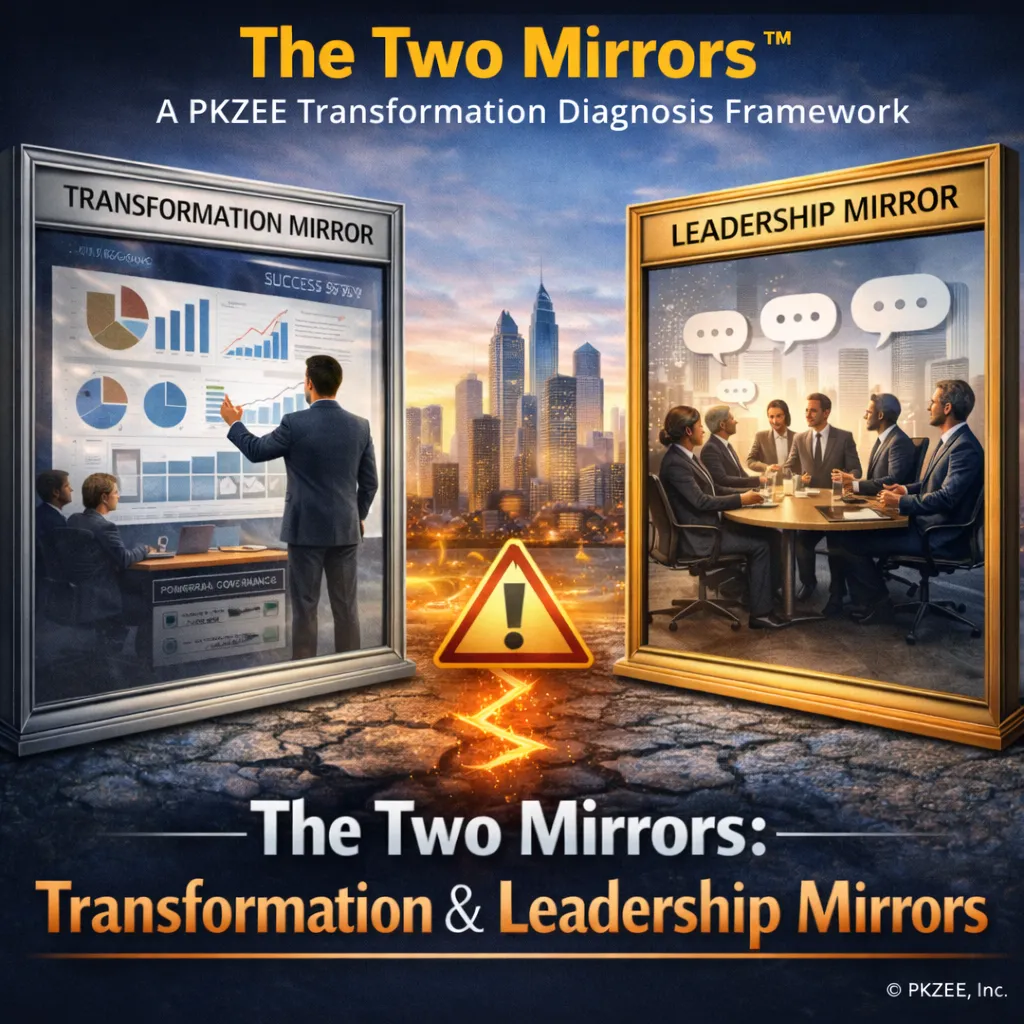
The Two Mirrors
Transformation & Leadership Mirrors
What Do Your Enterprise & Transformation Leadership Teams Tell You About the Warning Signs of the Transformation?
A complete diagnostic guide for CEOs and Senior Executives navigating enterprise transformations for better outcomes and high ROI
Why the Transformation & Leadership Mirrors Together?
Enterprise transformation and executive leadership are not separate problems. They are the same problem, viewed from two different angles.
The transformation mirror shows you the warning signs that appear in your programme — the governance gaps, the delivery risks, the leadership blind spots that manifest in the work itself. The leadership mirror shows you what those organisational patterns are reflecting back about you.
Most leaders who are navigating a significant transformation focus on one mirror or the other. The ones who look into both — honestly, at the same time — are the ones whose transformations succeed. And whose leadership is permanently stronger for the experience.
This guide holds up both mirrors. Read it in order.
The second half will make more sense if you have read the first.
PART ONE
The Transformation Mirror
The 7 warning signs that enterprise transformations fail — and the diagnostic question at the heart of each one.
PART TWO
The Leadership Mirror
Eight questions that reveal what your organisation's struggles are reflecting about your leadership — answered honestly.
PART ONE
The Transformation Mirror
The 7 Warning Signs That Leaders Miss Until It's Too Late
Most transformation failure is not a technology problem, a resourcing problem, or the problem that is in the status report. The same warning signs appear in organisation after organisation — not because the leaders are incompetent, but because these signals are designed to be invisible until they are not.
Important: Read these honestly — not as an academic exercise, but as a mirror held up to your own programme. If you recognise three or more, your programme is at higher risk than your governance documents are showing you. That is not a criticism. It is recoverable information.
1
The transformation has a sponsor, but no one who owns the outcome.
There is a difference between executive sponsorship and executive accountability. Sponsors attend steering committee meetings and approve budgets. They do not lie awake at 3am thinking about delivery risk. If your transformation has sponsors but no single person who feels personally accountable when things go wrong — the warning sign is not in the governance chart. It is in who gets the call when a milestone slips.
The diagnostic question: If this transformation missed its next major milestone tomorrow, whose phone would ring first — and would that person be surprised by the call?
2
The programme has momentum, but the organisation is not changing.
Delivery momentum and organisational change are not the same thing. A programme can run on time, on budget, and still leave the organisation essentially unchanged at the end. Workstreams close, milestones are ticked, and six months later the behaviours, decisions, and capabilities look exactly as they did before the programme began.
The diagnostic question: Has anything about how your senior leaders make decisions actually changed since this transformation started? Not the process — the actual decisions.
3
Risk is being managed. Risk is not being told.
Every transformation has a risk register. Most risk registers are a work of institutional optimism. Risks are amber when they should be red. The real risks — the ones that would change a board's view of the programme — are known by three people in the room and mentioned by none of them. Not out of dishonesty. Out of the very human preference for not being the person who says the thing no one wants to hear.
The diagnostic question: When did someone last tell you something genuinely uncomfortable about this transformation in a formal governance setting? If the answer is 'I cannot remember,' the governance is not working.
4
The delivery partner is managing the relationship, not the outcome.
Your implementation partner's primary commercial interest is the continuation of the engagement. When a delivery partner is managing the relationship rather than the outcome, you will see: escalations that are carefully worded, progress reports that emphasise the positive, and scope changes that are framed as opportunities rather than risks.
The diagnostic question: When your delivery partner brings you a change request or a timeline revision, who in your organisation has the independence and the mandate to push back — and be heard?
5
The leadership team is aligned in meetings. Nowhere else.
Executive alignment is one of the most consistently misread signals in transformation governance. Leaders who disagree rarely say so directly. They say it through priorities, through the decisions they make when governance attention is elsewhere, and through the subtle withdrawal of organisational energy from the programme. Meeting-room alignment is not the same as genuine commitment.
The diagnostic question: If you asked each member of your executive team privately — not in a governance meeting — whether this transformation will succeed, would you get the same answer from all of them?
6
The transformation is being delivered to the organisation, not built with it.
Transformations that are delivered to an organisation — however well-executed — produce results that last as long as the programme does. When the consultants leave, the governance atrophies, the capability dissipates, and the organisation slowly returns to its previous state. Sustainable transformation requires that capability is built throughout the programme, not handed over at the end.
The diagnostic question: When this engagement ends, what will your organisation be able to do that it cannot do today? Not what will have been built — what will your people be able to do?
7
You are getting the information your team thinks you want to hear.
The most dangerous transformation environment is not one with poor governance. It is one where a capable CEO has — through entirely reasonable behaviour — created an environment where people bring them the version of the news that is easiest to receive. If your governance is consistently showing amber when the reality is red, the signal is not in the data. It is in the room.
The diagnostic question: Who in your organisation has the relationship, the independence, and the courage to tell you the thing you do not want to hear? And when did they last do it?
WHAT TO DO WITH WHAT YOU HAVE JUST READ
If you recognise fewer than two of these signs: your programme is in reasonable health. The risk is complacency — the belief that because things look stable, they are stable. Keep your governance honest and your challenge rigorous.
If you recognise two or three: you have identifiable risks that are manageable if addressed now. The window is open, but it will not stay open indefinitely. The question is whether you have the right people around you to address them.
If you recognise four or more: your transformation needs intervention, not optimisation. Not a governance refresh. Not a new delivery framework. A person who will stand next to you, take personal accountability for the outcome, and tell you the truth in every conversation.
The pattern: The organizations that successfully rescue at-risk transformations do not do it by working harder within the existing structure. They change one thing: they bring in someone who is personally accountable for the outcome and has the independence to say what is true.
PART TWO
The Leadership Mirror
Eight Questions for CEOs and Senior Executives — Answered Honestly
This section of the guide is different in character from the first. Part One asked you to look at your transformation. Part Two asks you to look at yourself.
The questions below are the kind that an ICF Master Certified Coach asks in the early sessions of an engagement. They are not comfortable questions. They are not designed to be. The insight is in the specific place where you hesitate, deflect, or feel the impulse to qualify your answer — because that place is exactly the one worth examining.
Do not answer these with the version you would give in a board meeting or a performance review. Answer them with the version you have in your own head — the one that keeps you honest with yourself at 11pm.
Part A: What Your Organisation Is Showing You
Question 1
"When things go wrong in your transformation, where does attention go first — to understanding what happened, or to managing how it looks?"
Leaders who feel safe create organisations where understanding matters more than appearance. Leaders who do not — however senior and competent — create organisations where the appearance of control is protected ahead of the truth. This is not a moral failing. It is the entirely predictable result of accumulated anxiety in the system, starting at the top.
Question 2
"If you removed yourself from the room, would your executive team make the same decisions?"
This is not about whether they would make good decisions. It is about whether they can make decisions at all. Organisations whose leaders depend on the CEO to break every impasse have a capability gap that no governance process can fix. The gap is not in the process. It is in whether genuine authority has been genuinely distributed — or whether it has been described as distributed while remaining, in practice, centralised.
Question 3
"When your delivery partner tells you the programme is on track, do you believe them?"
Notice the quality of your honest answer. Not the official answer — the one you give in steering meetings. The actual answer: the one you have at 11pm when you are reviewing the data. If there is a gap between those two answers, that gap is where the risk lives. And it is also where your own role becomes important — because you almost certainly know what you know, and you are choosing, for understandable reasons, to allow the official version to stand.
Question 4
"Who tells you things you do not want to hear — and do they feel safe doing it?"
The answer to this question is a direct measure of the psychological safety in your immediate circle. Leaders who create genuinely safe environments for honest challenge receive honest challenge. If the honest answer is 'no one, really' — that is the most important piece of information in this entire guide.
Part B: What Your Own Thought Patterns Are Showing You
Question 5
"When did you last change your mind about something significant because of what someone told you?"
This is not about whether you are open-minded in principle. It is about whether openness is happening in practice. The leaders who change their minds regularly — and can name the specific moment and the specific person — tend to be the ones whose organisations can adapt. The leaders who struggle to answer this question are often operating in an echo chamber they did not design and do not recognise.
Question 6
"What is the version of yourself that your team sees under pressure — and is it the version you would choose?"
Every leader has a 'pressure self' — the version that shows up when the stakes are high and the margin for error is small. That version is often different from the composed, considered leader they aspire to be. The gap between the two is not a character flaw. It is information. The question is whether you know the gap exists, and whether you are doing anything about it.
Question 7
"What are you tolerating in your organisation that you would not tolerate if you had to explain it to a board that asked hard questions?"
Most leaders carry a private list of things they know are not right but have not addressed. A direct report who is underperforming but whom everyone likes. A governance process that looks robust on paper but is not functioning. A relationship with a delivery partner that is polite but not honest. The tolerance is always rational. The question is whether the reason is good enough to justify what the tolerance is costing.
Question 8
"If this transformation fails, what will be your private explanation of why?"
Do not answer with the official version. The board version, the press version — not that. The one you have in your own head. The hypothesis that keeps you up at night. That version. Because that version is almost certainly closer to the truth than any status report. And what you do with it — whether you bring it into the room or keep it private — is one of the most consequential decisions you will make.
WHAT ARE THE TWO MIRRORS SHOWING YOU TOGETHER?
Part One asked you to look at the warning signs in your transformation. Part Two asked you to look at the leadership patterns underneath them. If you have read both honestly, you will have noticed something:
The warning signs in Part One and the leadership patterns in Part Two are not independent. They are the same reality seen from two angles. The transformation that has sponsors but no owner reflects the leader who has distributed accountability on paper but not in practice. The governance that shows amber when the reality is red reflects the leader whose team does not feel safe bringing the red. The delivery partner managing the relationship, not the outcome, is surviving in an environment where independent challenge is unwelcome.
This is not criticism. It is a pattern — and patterns can be changed. The leaders who make the biggest breakthroughs in transformation are almost never the ones who change their strategy. They are the ones who change their relationship with the truth about their situation.
WHAT CAN STILL CHANGE THE OUTCOME?
Two things change the pattern reliably. One is independent governance — a person or structure that has both the mandate and the standing to tell you what is true, regardless of how welcome it is. The other is executive coaching — a relationship with someone who has no stake in the outcome except your growth, and whose job is to ask the question you have been avoiding.
The organisations whose transformations succeed — and whose leaders are stronger at the end than they were at the start — almost always have both.
What is unusual about PKZEE engagements is that both are built into the same retainer, delivered by the same person, across the same programme. The transformation governance and the personal coaching are not separate services. They are two parts of the same integrated partnership — and each one makes the other more effective.
IF THIS GUIDE LANDED — THE NEXT STEP IS SIMPLE
30 minutes. No pitch. No pressure. Prem will ask about your transformation and your leadership situation. You can ask him anything. At the end of the call he will tell you honestly whether one of these engagements is the right fit — and if so, which one.
PKZEE, Inc. | Transforming Enterprises and Elevating Leaders with Startegy, Clarity, and Human Touch
Quick Links
Resources


Copyrights: All rights reserved to PKZEE, Inc., 23027 Julieann Ct, Farmington HIlls, Michigan, USA